


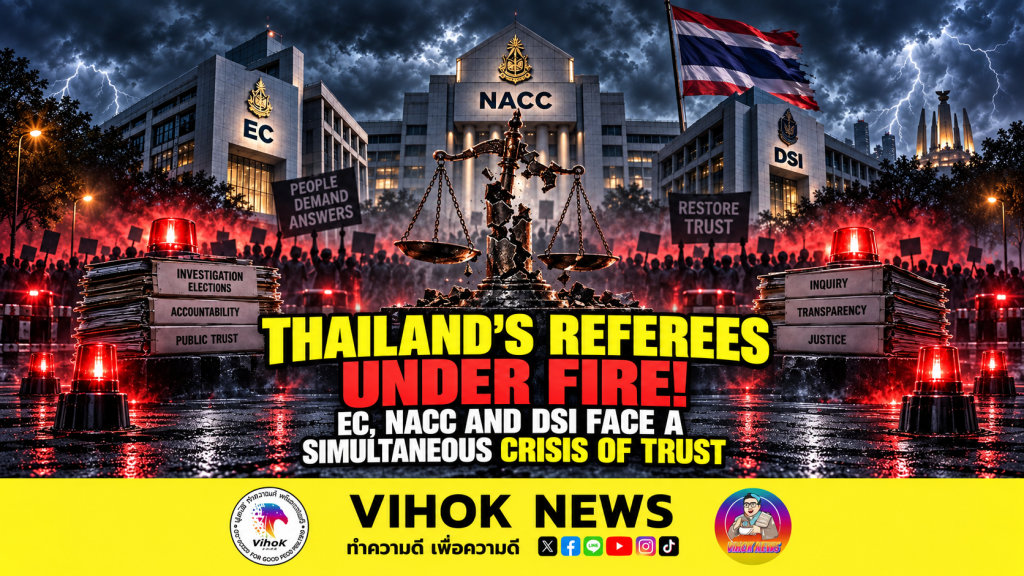
Bangkok, September 5, 2026 — Thailand’s political confrontation is no longer confined to Parliament or party politics. Over the past week, three powerful institutions — the Election Commission (EC), National Anti-Corruption Commission (NACC) and Department of Special Investigation (DSI) — have all come under intense scrutiny over politically sensitive cases.
The controversies are separate and there is no verified evidence that the three institutions are acting together or under a single political command. But their decisions can directly affect political power, turning the credibility of Thailand’s institutional “referees” into a political issue in its own right.
The most closely watched case involves allegations surrounding the Senate selection process.
The EC is preparing to consider a case involving 229 accused individuals — 138 sitting senators and 91 others. The case has already produced sharply different assessments inside the process: investigators reportedly recommended proceeding, while another panel voted 5–2 to recommend dropping the allegations.
The full Election Commission is expected to consider the case on September 14, 2026, putting the spotlight not only on the allegations themselves but also on the evidentiary standard the EC will use.
Meanwhile, the NACC is facing renewed questions over the pace of politically sensitive investigations.
Former Election Commissioner Somchai Srisutthiyakorn publicly raised questions on August 31 over the progress of a case involving an alleged 300,000-baht payment that has remained under scrutiny for years.
The allegation has not been established as wrongdoing, but the controversy has revived a broader concern: why do some high-profile cases appear to move rapidly while others remain unresolved for years?
The DSI has also been pulled into the spotlight after a disciplinary investigation was ordered against Pol. Maj. Natthaphon Ditsayatham, a senior DSI official who had been involved in several sensitive investigations.
Natthaphon has challenged aspects of the disciplinary process and questioned its background. Reports have linked the dispute to investigations he previously handled, but claims that the disciplinary action represents political retaliation or an attempt to derail particular cases remain unproven.
Taken together, the developments have created an unusual moment in Thai politics.
The EC is being watched over how it handles the Senate case.
The NACC faces questions over the speed and consistency of investigations.
The DSI must defend the transparency of disciplinary action involving one of its own senior investigators.
None of these controversies has reached a final legal conclusion.
But one consequence is already visible: public confidence in the institutions responsible for investigating, screening and advancing politically sensitive cases has itself become part of Thailand’s political struggle.
For Thailand, the immediate challenge is therefore larger than any single case.
When institutions capable of determining whether cases advance, stall or end become politically contested, the credibility of the process can become almost as important as the eventual verdict.
Vihok News
Sources: Election Commission of Thailand, Department of Special Investigation, Thai PBS, Matichon, Thansettakij, THE STANDARD and related reporting, reviewed through September 5, 2026.
#Thailand #ThaiPolitics #ElectionCommission #NACC #DSI #RuleOfLaw #JusticeSystem #InstitutionalTrust #VihokNews