


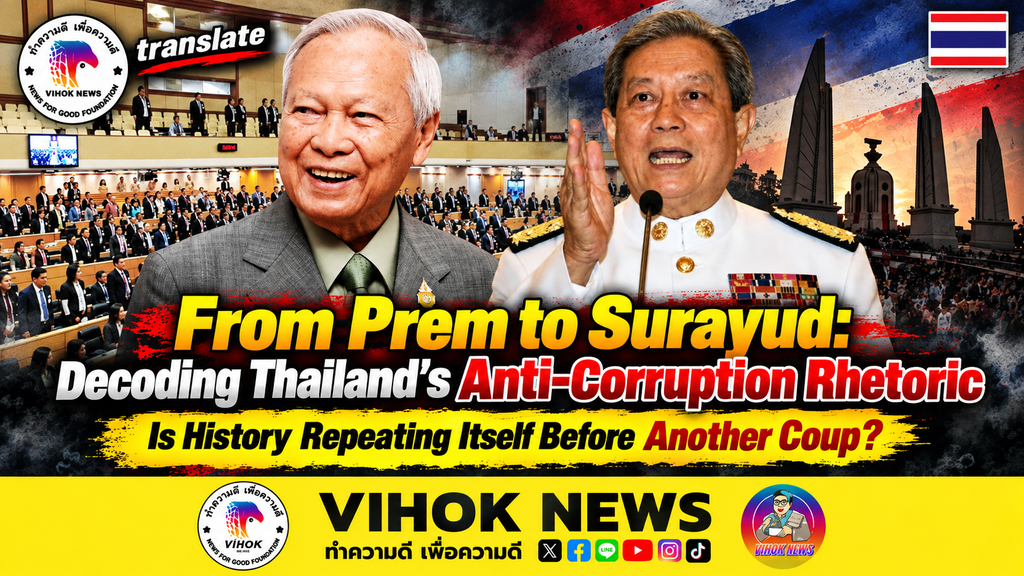
Is History Repeating Itself Before Another Coup?
Statements about morality and corruption by Thailand’s Privy Council presidents often attract attention during periods of political tension.
On 11 September 2026, Gen. Surayud Chulanont, President of the Privy Council, said Thailand remains “weak in prevention” because the country tends to focus more on punishing corruption after it occurs.
The question is whether this resembles the political rhetoric seen before previous coups.
Before the 2006 Coup
On 8 February 2006, Gen. Prem Tinsulanonda, then President of the Privy Council, stressed that national leaders needed not only competence, but also integrity, honesty and commitment to the national interest.
On 14 July 2006, Prem famously compared the government to a “jockey” and the military to a “horse,” emphasizing that governments temporarily administer the country but do not own the nation or the armed forces.
About two months later, on 19 September 2006, the military led by Gen. Sonthi Boonyaratglin seized power from the caretaker government of Thaksin Shinawatra.
Some academics and political actors later interpreted Prem’s remarks as undermining the government’s legitimacy or signaling the military. However, there is no direct evidence that his speeches constituted an order for, or caused, the coup.
“Do Not Wai to Corrupt People”
Prem’s well-known statement—
“We must be courageous enough not to wai to corrupt people.”
—was made on 19 December 2014, about seven months after the military coup of 22 May 2014.
In 2015, he also described corruption as “robbing the nation.”
These remarks therefore came after the coup, not before it.
Surayud’s Latest Remarks
Surayud’s latest speech focused on corruption prevention, good governance and personal integrity. He argued that anti-corruption efforts should involve government agencies, state enterprises, the private sector, academics and citizens.
Unlike Prem’s 2006 remarks, Surayud did not discuss military intervention, the government-military relationship or the seizure of political power.
What Is Similar — and What Is Different?
The similarity is clear: both Prem and Surayud linked corruption with morality, honest leadership and the national interest.
The difference is the political context. Prem’s 2006 speeches came amid severe political conflict and directly addressed the relationship between civilian government and the military.
Surayud’s latest remarks were delivered at an anti-corruption forum and focused on prevention and governance.
Conclusion
Anti-corruption rhetoric has previously formed part of the broader political environment surrounding Thailand’s coups in 2006 and 2014.
But based on the available evidence, there is not enough basis to conclude that Surayud’s latest remarks signal an impending coup.
What matters more than the rhetoric itself is whether it is followed by significant movements among political institutions, the military and other centers of power.
Vihok News
#PremTinsulanonda #SurayudChulanont #ThailandPolitics #Corruption #AntiCorruption #ThaiCoup #GoodGovernance #ThaiMilitary