


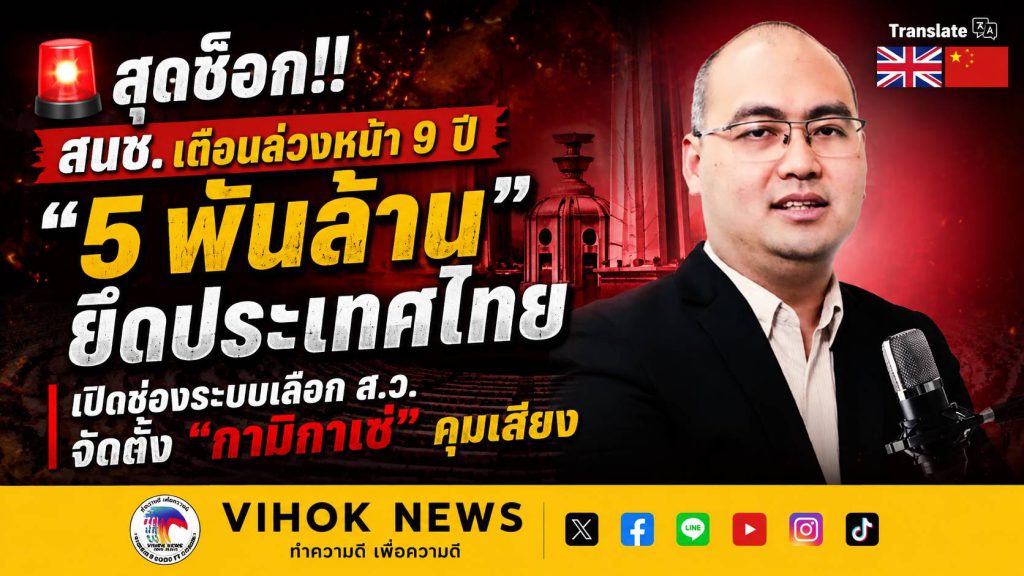
🚨 SHOCKING!! Former National Legislative Assembly Members Warned 9 Years Ago: “THB 5 Billion to Take Control of Thailand” — Exposing Loopholes in the Senate Election System and the Use of “Kamikaze” Candidates to Control Votes
🚨 震撼!9年前就有预警:“50亿泰铢控制泰国”——前国家立法议会议员揭示参议院选举制度漏洞,“神风敢死队”式候选人或可控制选票
กรุงเทพฯ — วันที่ 9 สิงหาคม 2569
ปมร้อนการเลือกสมาชิกวุฒิสภา หรือ ส.ว. 2567 ถูกขุดย้อนกลับไปถึงต้นทางของการออกแบบกฎหมาย หลังนักวิชาการเปิดข้อมูลจากรายงานการประชุมสภานิติบัญญัติแห่งชาติ หรือ สนช. ในปี 2560 พบว่า ปัญหาการบล็อกโหวตและการจัดตั้งผู้สมัครถูกตั้งข้อสังเกตเอาไว้ตั้งแต่ก่อนระบบถูกนำมาใช้จริง
ประเด็นดังกล่าวถูกนำเสนอโดย นายปุรวิชญ์ วัฒนสุข อาจารย์คณะรัฐศาสตร์ มหาวิทยาลัยธรรมศาสตร์ ในเวทีเจาะลึกหลักฐานเกี่ยวกับคดีเลือก ส.ว. โดยอ้างอิงเอกสารการประชุม สนช. ครั้งที่ 68/2560 วันที่ 30 พฤศจิกายน 2560
ข้อมูลจาก iLaw ระบุว่า ในการพิจารณาร่างกฎหมายว่าด้วยการได้มาซึ่ง ส.ว. สมาชิก สนช. หลายรายได้ตั้งข้อกังวลต่อระบบที่ออกแบบให้มีการแบ่งผู้สมัครเป็น 20 กลุ่มอาชีพ และใช้ระบบเลือกกันเอง รวมถึงการเลือกไขว้ระหว่างกลุ่ม (iLaw)
🚨 สนช.เคยเตือน “บล็อกโหวต” ตั้งแต่ยังไม่เริ่ม
หนึ่งในข้อสังเกตสำคัญมาจาก นายกล้าณรงค์ จันทิก สมาชิก สนช. ซึ่งประเมินโครงสร้างของระบบเลือก ส.ว.ว่า เมื่อผ่านการคัดเลือกในแต่ละระดับ จะเหลือผู้สมัครจำนวนหนึ่งที่สามารถถูกประสานหรือควบคุมเสียงได้
ข้อมูลที่นำเสนอระบุว่า หากผู้สมัครผ่านเข้ามาถึงระดับประเทศตามโครงสร้างดังกล่าว จะมีจำนวนผู้สมัครจำนวนมาก แต่การแบ่งสายและการเลือกไขว้ทำให้สามารถสร้างเครือข่ายควบคุมเสียงได้โดยใช้จำนวนคนไม่มากเมื่อเทียบกับผู้สมัครทั้งหมด
ข้อสังเกตดังกล่าวนำไปสู่คำเตือนว่า ระบบอาจเปิดช่องให้เกิด การซื้อเสียงและการบล็อกโหวต ได้ง่าย (iLaw)
💥 “ส่งคนเข้าไป” คุมเกมตั้งแต่ระดับอำเภอ
อีกหนึ่งคำเตือนมาจาก นายสมชาย แสวงการ สมาชิก สนช. ซึ่งยกบทเรียนจากการเลือกสมาชิกสภาร่างรัฐธรรมนูญปี 2550 ว่าเคยเกิดปัญหาการบล็อกโหวต และตั้งข้อสังเกตว่าระบบใหม่อาจเปิดทางให้พรรคการเมืองสามารถส่งบุคคลจำนวนมากเข้าไปสมัคร เพื่อควบคุมการเลือกตั้งตั้งแต่ระดับอำเภอ (iLaw)
ข้อมูลดังกล่าวถูกนำมาเชื่อมโยงกับคำเรียกที่ปรากฏในการอภิปรายว่า ผู้สมัครที่ถูกจัดตั้งเพื่อเข้าไปทำหน้าที่ลงคะแนนตามเป้าหมาย อาจถูกเรียกในลักษณะ “กามิกาเซ่” ซึ่งในบริบทปัจจุบันถูกนำไปเปรียบกับคำว่า “หน่วยพลีชีพ”
ประเด็นสำคัญไม่ได้อยู่ที่ว่าผู้สมัครทุกคนเป็นส่วนหนึ่งของการจัดตั้ง แต่คือคำเตือนของ สนช.ในเวลานั้นว่า โครงสร้างของระบบอาจเปิดช่องให้เกิดการจัดตั้งและบล็อกโหวตได้
🔥 “5 พันล้านยึดประเทศไทย” กลับมาเป็นประเด็น
ในการนำเสนอข้อมูลครั้งนี้ ยังมีการกล่าวถึงการประเมินในอดีตว่า หากสามารถจัดตั้งผู้สมัครและควบคุมเสียงได้เป็นระบบ อาจใช้เงินระดับ 5,000 ล้านบาท เพื่อเข้าควบคุมเสียงในวุฒิสภา ซึ่งถูกสรุปเป็นภาพใหญ่ในคำว่า “5 พันล้านยึดประเทศไทย”
อย่างไรก็ตาม ตัวเลขดังกล่าวต้องเข้าใจว่าเป็น การประเมินหรือคำเตือนที่ถูกหยิบยกจากบริบทการอภิปรายในอดีต ไม่ใช่หลักฐานยืนยันว่ามีการใช้เงินจริงจำนวน 5,000 ล้านบาทเพื่อควบคุมการเลือก ส.ว.
⚡ จากคำเตือนปี 2560 สู่การเลือก ส.ว. 2567
ระบบเลือก ส.ว.ตามรัฐธรรมนูญปี 2560 ถูกนำมาใช้จริงในการเลือก ส.ว. ปี 2567 และกระบวนการดังกล่าวก็เผชิญข้อกล่าวหาและข้อร้องเรียนเกี่ยวกับ การจัดตั้งผู้สมัคร การแลกคะแนน และการบล็อกโหวต
iLaw เคยรวบรวมข้อมูลจากผู้สมัครและผู้สังเกตการณ์การเลือก ส.ว. 2567 โดยมีคำบอกเล่าเกี่ยวกับการจ่ายค่าตอบแทน การเตรียมคนล่วงหน้า และการแลกคะแนนในหลายพื้นที่ รวมถึงข้อสังเกตเกี่ยวกับกลุ่มผู้สมัครที่ถูกจัดเตรียมไว้เพื่อสนับสนุนผู้สมัครบางราย (iLaw)
เมื่อย้อนกลับไปดูเอกสารการประชุม สนช. จึงเห็นได้ว่า ข้อกังวลเรื่องช่องโหว่ของระบบไม่ได้เพิ่งเกิดขึ้นหลังการเลือก ส.ว. 2567 แต่ถูกตั้งคำถามตั้งแต่ขั้นตอนการออกแบบกฎหมายในปี 2560
ข้อมูลจาก iLaw ระบุด้วยว่า ในกระบวนการพิจารณากฎหมาย เคยมีการปรับเปลี่ยนโครงสร้างเกี่ยวกับกลุ่มอาชีพและการเลือกไขว้ แต่ท้ายที่สุดรูปแบบ 20 กลุ่มและการเลือกไขว้ยังกลับมาอยู่ในระบบที่ใช้จริง (iLaw)
🚨 คำถามใหญ่จึงย้อนกลับไปที่ “คนออกแบบระบบ”
จากข้อมูลทั้งหมด ประเด็นที่ถูกนำกลับมาถกเถียงในปี 2569 จึงไม่ใช่เพียงว่ามีใครกระทำผิดในการเลือก ส.ว. 2567 หรือไม่ แต่ยังรวมถึงคำถามว่า ระบบที่ถูกออกแบบตั้งแต่ปี 2560 มีช่องโหว่ที่เปิดโอกาสให้เกิดการจัดตั้งและบล็อกโหวตจริงหรือไม่
เพราะสิ่งที่น่าสนใจที่สุดคือ คำเตือนเรื่องการควบคุมเสียงและการจัดตั้งผู้สมัครถูกบันทึกไว้ในรายงานการประชุม สนช. ตั้งแต่ 30 พฤศจิกายน 2560 ก่อนที่ระบบนี้จะถูกนำมาใช้ในการเลือก ส.ว. 2567 หลายปี
วันนี้ เมื่อมีข้อกล่าวหาเกี่ยวกับ “โค้ช” “โพย” “การจัดตั้ง” และ “หน่วยพลีชีพ” ปรากฏขึ้นอีกครั้ง คำเตือนจากเอกสารเมื่อเกือบ 9 ปีก่อนจึงถูกนำกลับมาเทียบกับพฤติการณ์ที่ถูกกล่าวหาในการเลือก ส.ว. 2567 อย่างหลีกเลี่ยงไม่ได้
สำนักข่าววิหคนิวส์
อ้างอิง: รายงานการประชุม สนช. ครั้งที่ 68/2560 วันที่ 30 พฤศจิกายน 2560 ตามข้อมูลที่นายปุรวิชญ์ วัฒนสุขนำเสนอ และข้อมูล iLaw เกี่ยวกับการตรวจสอบกระบวนการเลือก ส.ว. 2567 (iLaw)
🚨 SHOCKING!! Former National Legislative Assembly Members Warned 9 Years Ago: “THB 5 Billion to Take Control of Thailand” — Exposing Loopholes in the Senate Election System and the Use of “Kamikaze” Candidates to Control Votes
Bangkok — August 9, 2026
The controversy surrounding Thailand’s 2024 Senate election has now been traced back to the original design of the electoral system after an academic presented information from the records of the National Legislative Assembly (NLA) in 2017, showing that concerns over vote-blocking and organized candidates had already been raised before the system was put into practice.
The issue was presented by Purawit Wattanasuk, a lecturer at the Faculty of Political Science, Thammasat University, during a forum examining evidence related to the Senate election case. He referred to the minutes of the NLA meeting No. 68/2017, held on November 30, 2017.
According to information compiled by iLaw, during deliberations on the legislation governing the acquisition of senators, several NLA members raised concerns about a system that divided candidates into 20 professional groups, used a self-selection process, and included cross-group voting.
🚨 NLA Members Warned About “Vote Blocking” Before the System Even Began
One of the key observations came from Klanarong Chantik, an NLA member, who assessed the structure of the Senate selection system and warned that after candidates passed through each stage, a certain number of candidates could potentially be coordinated or their votes controlled.
The information presented indicated that if candidates advanced to the national level under the proposed structure, there would be a large number of candidates. However, the division into groups and cross-voting mechanism could potentially allow a network to control votes using a relatively small number of people compared with the total number of candidates.
These concerns led to warnings that the system could create opportunities for vote-buying and vote-blocking.
💥 “Send People In” to Control the Game from the District Level
Another warning came from Somchai Sawangkarn, an NLA member, who cited lessons from the 2007 election of members of the Constitution Drafting Assembly, where vote-blocking problems had reportedly occurred.
He questioned whether the new system could allow political parties to send large numbers of people to enter the candidate pool in order to influence the election from the district level.
The information has been linked to the term “kamikaze”, which reportedly appeared in the parliamentary debate to describe candidates allegedly organized to enter the process and cast votes according to a predetermined objective. In the current context, the term has been compared to the idea of “sacrificial units.”
The key issue is not that every candidate was part of an organized operation, but that NLA members at the time warned that the structure of the system could create opportunities for organized candidate networks and vote-blocking.
🔥 “THB 5 Billion to Take Control of Thailand” Returns to the Spotlight
The latest presentation also referred to a historical estimate that if candidates could be systematically organized and their votes controlled, as much as THB 5 billion could potentially be used to gain control over votes in the Senate. This was summarized in the dramatic phrase “THB 5 billion to take control of Thailand.”
However, the figure should be understood as an estimate or warning raised in the context of an earlier parliamentary debate, rather than evidence proving that THB 5 billion was actually spent to control the Senate election.
⚡ From the 2017 Warning to the 2024 Senate Election
The Senate election system established under the 2017 Constitution was ultimately used in the 2024 Senate election. That process subsequently faced allegations and complaints involving organized candidates, vote exchanges, and vote-blocking.
iLaw previously compiled information from candidates and observers of the 2024 Senate election, including accounts concerning alleged payments, advance preparation of candidate groups, and vote exchanges in various areas, as well as observations about groups of candidates allegedly prepared to support particular candidates.
Looking back at the NLA meeting records therefore shows that concerns about loopholes in the system did not emerge only after the 2024 Senate election. Questions about the system had already been raised during the legislative design process in 2017.
According to iLaw, the legislative process also involved changes to the structure of professional groups and cross-voting mechanisms. Ultimately, however, the 20-group structure and cross-voting system remained part of the system that was actually implemented.
🚨 The Big Question Now Turns Back to the “Designers of the System”
Based on all of this information, the debate in 2026 is no longer limited to whether anyone committed wrongdoing during the 2024 Senate election. It also raises the question of whether the system designed in 2017 contained structural loopholes that genuinely allowed organized candidate networks and vote-blocking to occur.
The most striking point is that warnings about vote control and organized candidates were recorded in the NLA meeting minutes as early as November 30, 2017, years before the system was used in the 2024 Senate election.
Today, with allegations involving “coaches,” “voting lists,” “organized candidates,” and “sacrificial units” resurfacing, the warnings contained in documents from nearly nine years ago are inevitably being compared with the alleged conduct surrounding the 2024 Senate election.
Vihok News
References: Minutes of National Legislative Assembly Meeting No. 68/2017, November 30, 2017, as presented by Purawit Wattanasuk, together with iLaw information concerning investigations into the 2024 Senate election process.
PurawitWattanasuk #SenateElection #SenateElection2024 #VoteBlocking #VoteBuying #ThaiPolitics #NationalLegislativeAssembly #NLA #iLaw #Thailand #Senate #VihokNews
🚨 震撼!9年前就有预警:“50亿泰铢控制泰国”——前国家立法议会议员揭示参议院选举制度漏洞,“神风敢死队”式候选人或可控制选票
曼谷 — 2026年8月9日
围绕泰国2024年参议院选举的争议,如今被进一步追溯到相关法律制度最初的设计阶段。一名学者公布了国家立法议会(NLA)2017年会议记录中的相关信息,显示早在该制度真正实施之前,议员们就已经对“封锁选票”以及组织候选人等问题提出过警告。
这一议题由法政大学政治学系讲师 Purawit Wattanasuk(ปุรวิชญ์ วัฒนสุข)在一场深入分析参议院选举案件证据的论坛上提出。他引用了国家立法议会 2017年第68次会议的会议记录,该会议于2017年11月30日举行。
根据 iLaw 整理的信息,在审议有关参议员产生方式的法律草案时,多名国家立法议会议员曾对相关制度表示担忧。该制度将候选人划分为20个职业组别,采用相互选择机制,并包括不同组别之间的交叉投票。
🚨 制度尚未实施,国家立法议会就已警告“封锁选票”
其中一项重要意见来自国家立法议会议员 Klanarong Chantik(กล้าณรงค์ จันทิก)。他当时分析参议院选举制度的结构,并警告称,候选人在通过各级筛选后,可能出现一定数量的候选人被协调、组织,甚至形成对选票进行控制的情况。
根据此次公布的信息,如果候选人按照这一制度进入全国层级,人数将非常庞大。但通过组别划分以及交叉投票机制,有可能只需要相对少量的人,就形成一个能够影响或控制选票的网络。
因此,当时便出现了关于该制度可能为买票及封锁选票创造机会的警告。
💥 “派人进去”——从县级开始控制选举
另一项警告来自国家立法议会议员 Somchai Sawangkarn(สมชาย แสวงการ)。他引用2007年宪法起草机构成员选举的经验,指出当时曾出现封锁选票等问题。
他当时提出疑问:新的选举制度是否可能让政党派出大量人员进入候选人体系,从而从县级选举开始影响甚至控制整个选举过程。
相关讨论后来被联系到“神风敢死队(Kamikaze)”这一说法。据称,在当时的讨论语境中,该词被用于描述那些被组织进入选举程序,并按照预定目标进行投票的候选人。在当前讨论中,这一说法被进一步比喻为“敢死队式选票单位”。
但需要强调的是,问题并不意味着所有候选人都是某种组织行动的一部分,而是当时国家立法议会已经提出警告:制度结构本身可能为组织候选人和封锁选票留下空间。
🔥 “50亿泰铢控制泰国”再次成为焦点
此次公布的信息还提到了过去的一项估算:如果能够系统性组织候选人并控制选票,理论上可能需要约50亿泰铢,以实现对参议院选票的控制。这一说法后来被概括成具有强烈冲击力的标题——“50亿泰铢控制泰国”。
不过,这一数字必须被理解为过去相关议会讨论背景下提出的估算或警告,而不是证明有人确实花费50亿泰铢来控制参议院选举的证据。
⚡ 从2017年的预警,到2024年参议院选举
根据2017年宪法建立的参议院选举制度最终在2024年正式实施。随后,这场选举面临多项有关组织候选人、交换选票以及封锁选票的指控和投诉。
此前,iLaw 曾从2024年参议院候选人及选举观察人士处收集相关信息,其中包括有关支付报酬、提前组织人员以及在多个地区进行选票交换的说法,同时也出现了关于部分候选人群体可能被提前安排、以支持特定候选人的观察。
因此,重新查看国家立法议会的会议记录可以发现,有关这一制度漏洞的担忧并不是在2024年参议院选举结束后才出现,而是在2017年法律制度设计阶段就已经有人提出质疑。
根据 iLaw 的资料,在法律审议过程中,关于职业组别以及交叉投票的制度设计也曾发生调整。但最终,20个职业组别和交叉投票机制仍然出现在实际实施的制度中。
🚨 最大问题重新指向“制度设计者”
综合这些信息,2026年的争议已经不再只是“2024年参议院选举中是否有人违法”这么简单,同时也引出了另一个关键问题:
2017年设计的参议院选举制度,是否确实存在能够让组织候选人和封锁选票发生的结构性漏洞?
最值得关注的是,有关控制选票和组织候选人的警告,早在2017年11月30日就已经被记录在国家立法议会的正式会议记录中,而当时距离这一制度真正用于2024年参议院选举还有数年。
如今,随着“教练(Coach)”“投票名单(โพย)”“组织候选人”以及“敢死队式候选人”等相关指控再次出现,近9年前文件中的这些警告,也不可避免地被重新拿来与2024年参议院选举中被指称的相关行为进行比较。
Vihok News(维霍克新闻)
参考资料: 国家立法议会2017年第68次会议记录(2017年11月30日),以及 Purawit Wattanasuk 在相关论坛中引用和介绍的资料;同时参考 iLaw 关于2024年参议院选举过程调查的公开信息。